


Christopher Graham
Founder & CEO
Since we started working with the Scottish Mentoring Network, I’ve found my mind turning increasingly to the of yore. I’ve long understood the power of mentoring, but working with Clair Smith and her excellent team has made me acutely aware of how much my own life was shaped by formative experiences.
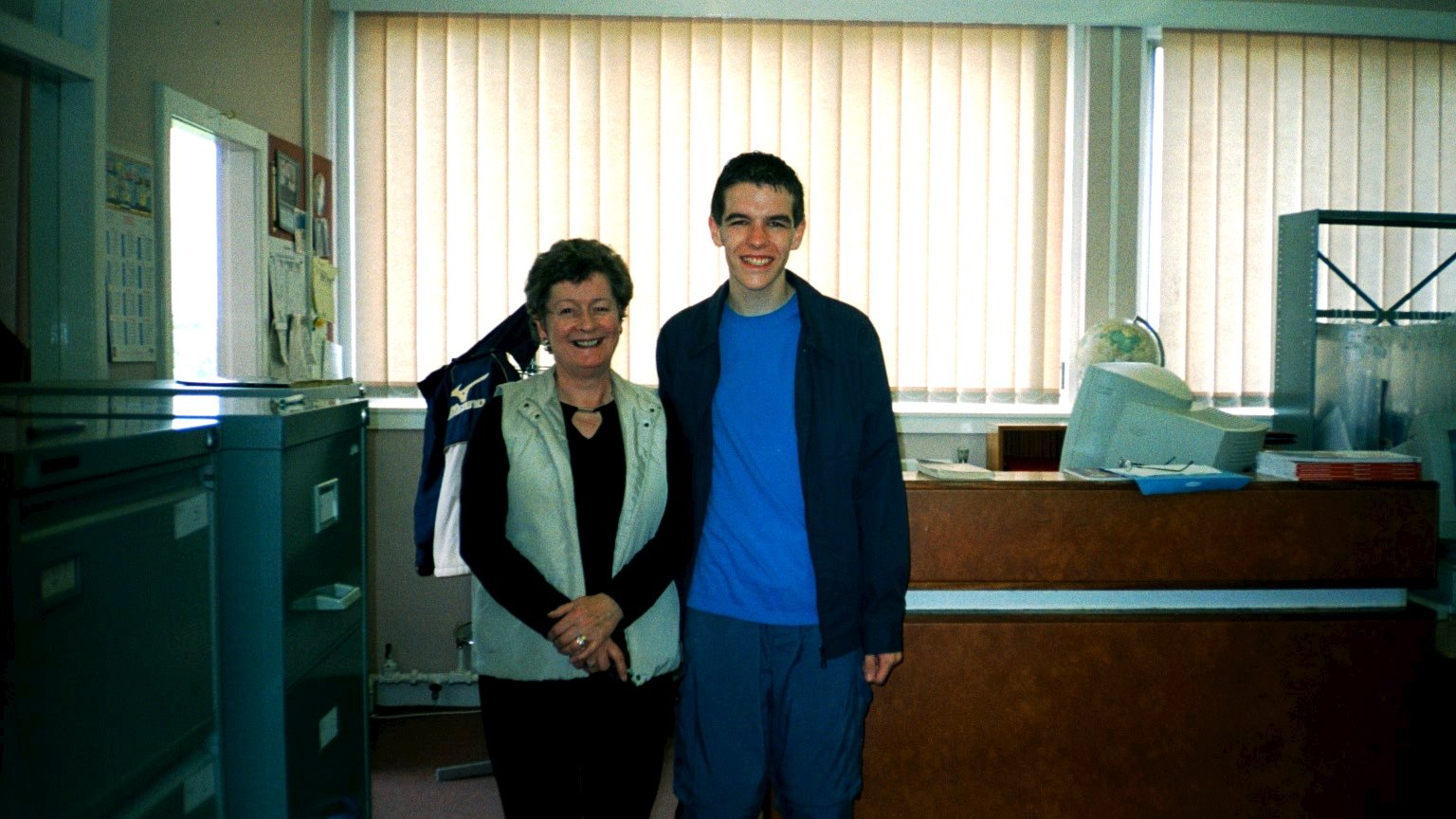
This is me just before Easter 2001, shortly before my 16th birthday. The woman beside me is Eleanor, my high school librarian. We met in May 1997, during an induction week before I started S1 properly that August. A keen reader, I’d wandered into the library, where she was struggling to register me on “the new system.” I offered to help, being fairly proficient with computers, and fixed the problem in five minutes. The system, she explained, had apparently been installed to make things more efficient. So far, it had merely confused her.
When school started properly that August, she stopped me outside the library: “You’re that boy who knows a lot about computers… can you come and help me with something?”
Eager to please in the strange, sometimes frightening world of high school, I agreed. This time it was a printer, only half removed from its box before she had abandoned the work in favour of outsourcing. By Christmas, anything remotely associated with computers had become my responsibility. My parents already expected me to help with domestic affairs at home, so responsibility wasn’t entirely unfamiliar. But this was different: an adult was trusting me to manage what seemed like important affairs in a strange new environment. It was a considerable milestone in my development. And, I don’t deny, an ego boost.
What I didn’t appreciate was how much I was learning by osmosis.
In early 1998, Eleanor turned to me while I was scanning returned books and said: “I’ve had an idea that I’d love to do, but I’d need your help.”
The school had recently installed an ISDN internet connection, a precursor to broadband, and 5000 miles away in California, Apple had unveiled the iMac. Eleanor had a proposition: “Why don’t we take over that empty classroom and turn it into a computer lab?”
“What for?” I asked, not immediately seeing the point.
“So that there’s a central place that’s open before lessons, after lessons and perhaps at lunchtime where every pupil can get on the internet, learn how it works, get information for homework and that sort of thing. You’re the one who’s always saying it’s the future.”
I thought it sounded genius. I had dial-up internet at home, on a second phone line my parents had begrudgingly agreed to, and knew I was one of very few people with that privilege. But I also had a million questions. Who would pay for the iMacs? Where would the furniture come from? How would we connect everything when the ISDN junction was three floors away?
“I’ll talk to the money men and get all that sorted,” she said, “But you will need to pick the right sort of iMac, and then we’ll need to work together on a programme to teach people how to use them, and when they get here you’ll need to set them all set up and connected because I don’t know anything about all that.”
Information technology in schools was considerably more laissez-faire then. Eleanor was able to announce the project and, remarkably, nobody questioned it. The powers that be agreed with just one condition: staff would supervise the lab, lest pupils encounter unsuitable content.
There was an enormous sense of achievement as things progressed. It was also my first lesson in marketing communications.
“How will people know about it if we don’t tell them?” Eleanor asked when I questioned the need for posters on every floor, an announcement in the student bulletin and remarks for the headteacher to deliver at assembly. It hadn’t occurred to me that good ideas needed an audience.
There were, of course, missteps. I decided, without seeing any reason to consult anyone, that one of the eight new iMacs should go into the Green Room, the little space off the library that Eleanor and I used as a combined office, storeroom and occasional dining room. I had rather taken to the idea of having one of the shiny new machines to myself.
Eleanor was not pleased. “We have told everyone there will be eight in the lab, so that means there has to be eight.” My objections were dismissed. If I wanted a computer in the Green Room, I would have to “make do with one of the older ones and think yourself lucky.”
It felt harsh. But we had made a promise, and there was no good reason to break it simply because I fancied a new computer. Another marketing lesson, though I wouldn’t have called it that at the time.
The lab was a huge success. Eleanor was conscious that many pupils came from disadvantaged backgrounds, and before long we had developed an entire programme of activities, ranging from basic coding classes to after school homework clubs at which soft drinks and snacks were served. It was an extraordinary opportunity for a teenager to be involved at this level, making decisions and pulling it all together.
Alongside the technology, I learned how organisations - and their politics - worked. Eleanor handled the original procurement, but as the years passed we bought newer computers and other equipment. She showed me how to make a case for spending money, explain an idea persuasively and understand what mattered to the person making the decision. These are skills I still use, every single day.
Other lessons were less tangible, but no less important. Sometimes things at home were difficult, and I carried a great deal of anger, sadness and frustration. Eleanor was happy to listen to my rants. I dread to think what people thought was going in in the Green Room sometimes. She offered perspectives that simply hadn’t entered my mind. When I struggled to understand the choices and behaviour of adults, she helped me see those situations without judgement or apportioning blame. She guided me through difficulties with subjects and teachers too. Those lessons stayed with me.
All of this was very informal. Across the school, though, it was understood that I was essentially Eleanor’s assistant. There were responsibilities, but privileges too. Arriving late for class could be explained with “Library business” - a superpower I tried not to abuse, but I did occasionally sail close to the wind. On one occasion I turned up for a French lesson with bags from Gap, River Island and Marks & Spencer after deciding I had earned an extended lunch break at the local shopping centre. This stretched the credibility of “Library business” to the extreme.
Shortly before I turned 18, Eleanor told me: “When you leave here… one day you’ll need to find some sort of organisation to run.”
“Because I’d be an amazing boss.” I concluded, stamping a return date into a book that had just been checked out.
“Because nobody else will bloody put up with managing you!” she retorted, pushing me aside to reach the front-desk computer which I was monopolising.
“Yeah I wonder where I get that from.” I fired back sarcastically. She laughed, then simply: “Books. Back on shelves before the bell goes.”
Sixteen years later over dinner, Eleanor explained that all these projects had been about giving young people practical experience and a head start in life. “There was entirely too much focus on academic achievement. It’s important obviously, but people also need to know how places run, and to get a sense of achievement from doing something tangible.”
My profession is communication, yet I still struggle to put into words the impact of that informal mentoring over those years.
Without Eleanor, there would be no TMD. I might never have learned to stop talking and listen to what people actually need, or to recognise that their decisions are shaped by circumstances of which I can see only a fraction. She taught me to resist easy conclusions and judgements.
I’ve had other mentors since, including people who helped me develop my career and build The Marketing Department. Those relationships were more structured, but the value of someone experienced who listens, challenges and offers practical guidance has been constant.
Working with the Scottish Mentoring Network has brought me back to that library and reminded me that mentoring’s effects aren’t always obvious at the time. Sometimes they become apparent only years later, in how someone approaches a problem, treats another person, or finds the confidence to build something of their own.
At TMD, our job is to help organisations communicate why their work matters. Helping Clair and the team at Scottish Mentoring Network tell the story of mentoring therefore feels especially personal. Eleanor never described what she was doing as mentoring. But the organisation I run today, and much of the person I became, are evidence of its enduring power.